The Market
4.1: Appreciation and the Retail Ratchet
The fundamental paradox of luxury consumption is that the acquisition of beauty typically requires the destruction of capital. For generations, the orthodox rule of tangible assets has been that physical utility guarantees financial decay. This rule is most glaringly evident in the automotive sector. Under the appraisal algorithms of institutions like Kelley Blue Book and Manheim, luxury automobiles suffer a front-loaded, linear depreciation curve directly linked to physical mileage and wear. A high-end vehicle loses 20 percent to 30 percent of its MSRP the moment its tires meet the public road, followed by a steady 10 percent to 15 percent annual decline.
The mechanical watch entirely subverts this paradigm. A high-end timepiece is completely immune to mechanical “mileage.” A beautifully finished movement does not lose intrinsic financial value simply because its balance wheel continues to oscillate. Horological wear is untrackable and easily reset via standard servicing. Horological value is dictated not by the odometer of its mainspring, but by the originality of its exterior components, its unpolished case geometry, and macro-market supply. Consequently, a collector can wear a $100,000 Patek Philippe every single day for five years and liquidate it for a profit—a mathematical impossibility with a daily-driven luxury automobile.
But immunity to depreciation is only a baseline; it does not explain exponential growth. The true engine of horological appreciation is structurally engineered by the primary manufacturers through a mechanism known as the “Retail Ratchet.”
The Retail Ratchet: The structural mechanism by which primary luxury watch manufacturers execute compounding, annual MSRP increases (typically 3% to 8%). Because authorized dealer waitlists restrict primary supply, these continuous primary price hikes act as a unidirectional ratchet, permanently pulling up the valuation floor of the secondary and pre-owned market.
To counter global monetary fluctuations, rising labor costs, and precious metal spot inflation, major Swiss watchmaking houses implement compounding, annual retail price increases commonly ranging from 3 percent to 8 percent. Rolex, for instance, executed steady, twice-yearly retail price increases across 2022, 2023, and 2024, resulting in cumulative retail increases of 7 percent to 8 percent on several core references. This primary price threshold serves as a unidirectional ratchet that pulls up the entire secondary market. Because authorized dealer (AD) allocation networks enforce strict waitlists—reducing the physical supply at boutiques to effectively zero for standard clients—the secondary market is forced to absorb the retail price hike. The pre-owned timepiece is revalued upward simply because its replacement cost in the primary market has ascended.
The historical trajectory of hero references lays this compounding math bare:
When the Rolex Submariner (Ref. 6204) launched in 1953, it carried a retail price of approximately $150. By the early 1970s, the Ref. 5513/1680 sat at roughly $230. By 2024, the steel Ref. 126610LN commanded $10,800—a near-monotonic 47x to 72x retail price climb.
Patek Philippe’s Nautilus follows an identical curve: the original Gérald Genta-designed steel Nautilus Ref. 3700 launched in 1976 for $3,100 (approximately 15,000 French Francs); upon its official discontinuation in late 2021, its modern steel successor (Ref. 5711/1A) carried an MSRP of $34,890.
The original steel Audemars Piguet Royal Oak (Ref. 5402ST) launched in 1972 at an astronomical CHF 3,300 (roughly $850 or £330)—higher than AP’s own gold dress watches at the time. Today, the current-production steel Royal Oak “Jumbo” Extra-Thin (Ref. 16202ST) retails at $40,100.
Yet, the Retail Ratchet only accounts for baseline growth. When structural scarcity collides with deep historical provenance, the resulting price multiples enter the stratosphere. The Rolex Cosmograph Daytona—specifically vintage references housing “exotic” dials manufactured by Jean Singer & Cie—represents one of the most remarkable revaluations in alternative asset history. During their obscurity era in the 1960s to 1980s, these exotic dials were commercial failures, languishing as highly unpopular catalog options. In 1980, a steel Daytona Ref. 6239 fitted with an exotic dial retailed and traded for approximately $200.
As the Italian dealer network codified the “Paul Newman” nomenclature in the late 1980s, these previously discarded dials became the ultimate status markers of horological discernment. By 2020, standard steel Paul Newman Ref. 6239 models routinely traded for $180,000 to $400,000, with highly scarce configurations exceeding $600,000. This trajectory reached its peak provenance event on October 26, 2017, when Paul Newman’s personal Rolex Daytona Ref. 6239 sold at Phillips in New York for $17,752,500. This historic transaction established a provenance multiplier exceeding 10,000 percent against an identical, non-provenance Ref. 6239 valued at $100,000 to $150,000 at the time.
Long-term institutional tracking data proves that these are not isolated anecdotes; they are indicative of a deeply resilient asset class. A rigorous hedonic-pricing model analyzing over 60,000 watch auction results over a two-decade window (1999–2020) verified that collectible watches achieved an annualized real return of 5.5 percent (7.7 percent nominal), outperforming the S&P 500, fine art, and classic cars.
Even as the market normalizes, the asset class remains robust. Over the trailing ten-year matrix (to Q4 2024), the Knight Frank Luxury Investment Index (KFLII) showed watches delivering a 125.1 percent to 138 percent capital appreciation, outperforming both classic cars (+82 percent to +118 percent) and fine art (+105 percent).
Looking forward, the financial ceiling for top-tier horological trophies remains largely undefined. Bolt notes his own concrete experience with this staggering trajectory: “I bought watches for about $20,000 before, and they’re worth $1.5 million now, so they can be an incredible investment.” A watch, ultimately, “can be an incredible investment” because the collectibles market for mechanical watches is in its relative infancy.
When measured against centuries-old asset classes, the growth headroom is vast. “If we look at that and compare it with how relatively young the wristwatch collectible market is, as opposed to art, as opposed to cars, even as opposed to gold, stocks, and shares, whatever you want, the room for growth is absolutely colossal.” Bolt frames this valuation gap: “If you think about a rare Patek Philippe or a rare Rolex today, I don’t know, let’s say it is between £2 million and £4 million. That is equivalent to an art piece. That is equivalent to a piece of art that today would be £50 million to £70 million, £100 million.”
The mechanical watch is no longer just an object of aesthetic fascination; it is a meticulously engineered financial instrument. Supported by a continuous retail ratchet from the primary manufacturers, shielded from physical depreciation, and bolstered by a colossal headroom for growth, one of the most reliable stores of value in the modern luxury economy.
4.2: The Birth of the Investment Market
Today, the valuation of a vintage mechanical watch is a rigorous, data-driven exercise tracked by algorithmic indices and audited by investment banks. But for the majority of the twentieth century, a secondhand watch was simply a depreciating piece of obsolete machinery. To understand how a circle of brass, steel, and sapphire transitioned from a functional utility tool into an alternative asset class commanding million-dollar premiums, one must examine the specific cultural and economic catalysts that forged public price discovery.
The Era of Pure Subjectivity
Prior to the institutionalization of specialized watch auctions in the late 1980s, the secondary market operated in a state of absolute opacity. There were no standardized price registries, no global dealer networks, and no specialized horological media to dictate value. The trade was highly fragmented, existing in a vacuum of information where transactions were driven by arbitrary, localized haggling rather than structured comparables.
Bolt, whose career traces the exact arc of this market’s professionalization, captures the sheer informality of this nascent era. “If you look at the wristwatch market when I first got into it in the late 1980s, it was a tiny, tiny market,” Bolt recalls. “Pretty much, a watch was worth what someone wanted to give. There was no real market price for it. Auctions just started doing them, but they weren’t very prolific.”
The Hustle of the Pre-Digital Trade
Operating in this “wild west” of valuation required an entirely different set of practitioner instincts. In the late 1980s and early 1990s, Bolt navigated a trade dominated by conventional, old-school dealers operating at regional gatherings like the Brunel Watch Fair and the markets of Parma. It was a time when the modern collector’s fetishization of “untouched factory originality” did not yet exist; Bolt recalls early transactions involving gold Rolex “marriages”—watches cobbled together from disparate parts—trading easily for a mere £400.
Arbitrage in this period was physical, rapid, and delightfully analog. Bolt famously exploited the massive geographic price discrepancies of the era during the peak of the Swatch craze. Purchasing plastic Swatch chronographs—such as the “Wall Street” model—for £45 at retail in the UK, he would fill suitcases and fly them to Italy, flipping them to local retailers for double his investment. When the Swatch Group instituted a strict mandate restricting customers to a single chronograph per purchase, Bolt simply circumvented the corporate gatekeeping by standing outside the boutique and paying passersby a fiver to go inside and execute the purchases on his behalf.
The absolute lack of a codified market meant that objects of profound historical and mechanical significance languished at prices that are unimaginable today. Vintage Rolex-manufactured Panerais (Reference 3646), which today routinely command upwards of £170,000, were incredibly difficult for Bolt to offload for a mere £1,100. Manual-wind Rolex Daytona “Paul Newman” references—the very watches that would later define the auction landscape—were actively trading for a comparatively meager £3,000.
Rather than chasing the “sheep” mentality of speculative hype, Bolt anchors his philosophy in buying what is aesthetically cool and historically honest—an instinct forged in a time when there was no index to tell a dealer what a watch was supposed to be worth.
Forged in Fire: The Twin Attritions
The foundational prerequisite for any high-value asset class is scarcity. In the vintage watch market, this is defined as “Natural Scarcity”—a finite survivor population that cannot be artificially inflated. This scarcity was not merely a byproduct of low original production numbers; it was violently accelerated by two overlapping macroeconomic crises that devastated the mid-century watch population.
The first was the Quartz Crisis (1970–1988). The introduction of hyper-accurate, battery-powered quartz movements rendered the mechanical watch functionally obsolete overnight. This systemic industrial collapse was immediately compounded by the Great Gold Spike of 1979–1980. In response, owners and opportunistic dealers systematically stripped the solid gold cases from vintage mechanical timepieces and melted them down for scrap bullion value. This left behind a massive surplus of orphaned, high-grade mechanical calibers with zero scrap value.
This twin-headed attrition thinned the future survivor population exponentially, ensuring that key mid-century references became extraordinarily scarce. The resulting physical rarity of these objects is precisely documented in the modern market’s most coveted references:

Patek Philippe Reference 1518 (1941–1954): The world’s first perpetual calendar chronograph produced in series. Production was capped at just 281 examples, with an ultra-rare 4 known examples executed in stainless steel.
Patek Philippe Reference 2499 (1950–1985): Produced in only 349 units over a 35-year run, averaging a mere 10 watches per year. Only two known examples were produced in platinum (one of which later sold from Eric Clapton’s collection in 2012 for $3.63 million USD).
Patek Philippe Reference 3449 (1961): Manufactured in exactly three examples (movement serial numbers 799000, 799001, and 799002), all of which are fiercely tracked and accounted for today.
Patek Philippe Reference 2523: A double-crown world-time complication restricted to roughly 29 to 36 total examples, hand-assembled under strict physical constraints.
Rolex Daytona “Paul Newman” Dial: These “exotic” dials, manufactured by Jean Singer & Cie, appeared on only roughly 1 in 20 manual-wind Daytonas. Because they were initially slow-selling and commercially unpopular, many were destroyed or swapped for standard dials during routine servicing, drastically reducing the surviving population.
The Architect of “Provenance Theatre”
The transition of these rare survivors from forgotten curiosities into multi-million-dollar assets required an architect. The modern vintage watch market was effectively willed into existence by Osvaldo Patrizzi, who co-founded the Galerie d’Horlogerie Ancienne in Geneva in 1974 (later rebranding as Antiquorum SA in 1987).
In an era where Patrizzi estimated there were only about 300 serious watch collectors worldwide, the first specialized watch auction hosted by his firm realized an aggregate total of just SFr 1.8 million (approximately $1.38 million USD). But Patrizzi executed a crucial proof-of-concept for secondary market premiums: at an early Antiquorum sale, an unpolished Patek Philippe Reference 2499/100 hammered for 18,000 Swiss francs—visibly exceeding the neighboring Patek Philippe Geneva salon’s retail list price of 16,000 Swiss francs. It was the moment a secondhand watch proved it could transcend its status as a used tool and appreciate beyond its primary retail value.
Patrizzi achieved this by inventing “Provenance Theatre.” He pioneered the thematic auction format, producing lavish, heavily researched catalogs that provided the academic scaffolding necessary to justify high valuations. He also recognized the power of narrative, popularizing colorful Italian collector nicknames—the “Paul Newman” Daytona, the “Padellone” moonphase, the “Cornino” GMT-Master—to construct distinct identities for these objects. Bidders were no longer purchasing an obsolete timekeeping machine; they were publicly competing to acquire a certified fragment of history, converting emotional capital into hard, non-correlated market premiums.
Provenance Theatre: The curation methodology pioneered in the late 1980s by auctioneers like Osvaldo Patrizzi. By cataloging wristwatches with the academic rigor traditionally reserved for fine art, applying colorful Italian nicknames, and publishing detailed historical contexts, auction houses systematically converted obsolete timekeeping tools into romanticized, high-status cultural artifacts capable of commanding immense financial premiums.
The Big Bang: “The Art of Patek Philippe”
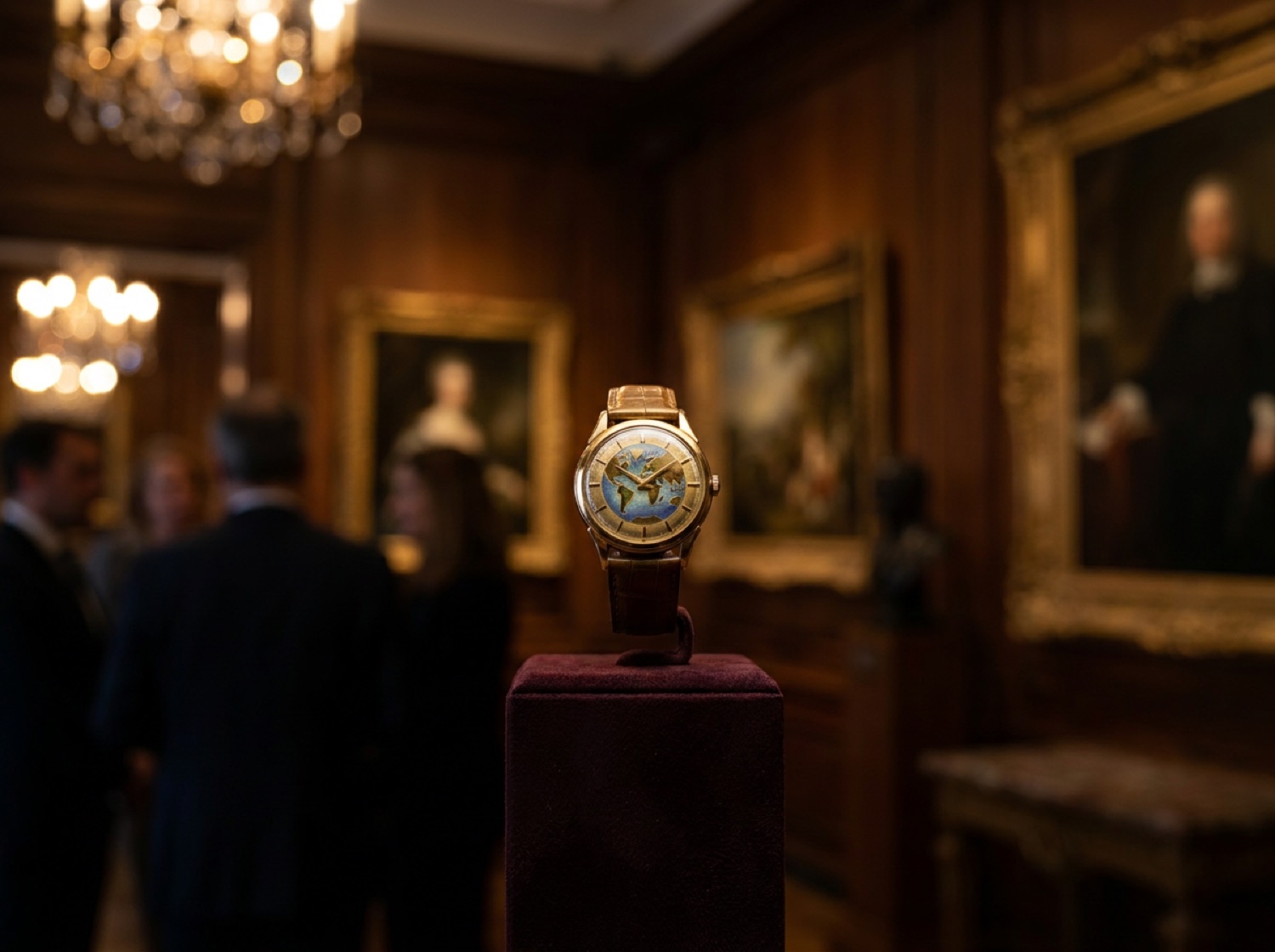
The moment horology definitively became a globally recognized alternative asset class occurred on April 9, 1989. Curated to coincide with Patek Philippe’s 150th anniversary, Antiquorum (in collaboration with Habsburg Feldman Fine Art Auctioneers) hosted “The Art of Patek Philippe” at the Hôtel des Bergues in Geneva.
Featuring 301 highly selective lots, the auction generated a groundbreaking aggregate turnover of approximately $15 million USD. The centerpiece was the legendary Calibre 89, an open-face clock-watch boasting 33 complications and 1,728 individual components. It achieved an unprecedented hammer price of CHF 4,950,000 (and would later resell in 2009 for CHF 5,120,000), establishing a headline-making valuation ceiling for the entire market.
This public auction format also introduced the vital mechanism of manufacturer intervention. Revered houses, most notably Patek Philippe, began actively entering global auction rooms to defensively bid on and reclaim historical pieces for their own museums. This operates exactly like a central bank’s open-market operations: by aggressively propping up the secondary price ceiling of their own historical references, manufacturers mathematically justify the premium pricing and waitlist-driven scarcity of their modern, current-production catalogs.
From Catalogs to Continuous Indexing
By compiling and publishing detailed historical contexts and hammer prices, auction houses established the first repeatable public comparables. Databases like Antiquorum’s archive of 65,000 transacted timepieces, Helmut Crott’s sales records, and Patrizzi’s 2004 multi-volume Collecting Patek Philippe provided the raw empirical data required to treat watches as trackable financial assets. Curation continued to drive value, as seen in subsequent landmark sales like Christie’s 2013 “Daytona: Lesson One” thematic auction.
This pipeline of price discovery reached its logical modern terminus on October 20, 2023, with the launch of ChronoPulse. Billed as the “Dow Jones” of the luxury watch industry, ChronoPulse established the first luxury watch index built entirely on actual transaction data rather than subjective dealer asking prices. Compiling over 4.6 million data points from 1 million sales to provide continuous, daily-updated market tracking it certified that the transformation was complete. The market had evolved from a chaotic bazaar where a watch was merely “worth what someone wanted to give,” into a highly disciplined, transparent financial ecosystem.
4.3: The Scarcity Machine
The defining characteristic of the modern luxury watch market is not merely its financial appreciation, but the architecture of the obstruction that drives it. To understand how a mass-produced steel object becomes an exclusive financial asset, one must examine the mechanics of engineered scarcity. The contemporary market is defined by a ruthless paradox: a structural “scissors” effect where total unit production plummets while aggregate revenue soars to historic highs.
Draft a dual-axis line graph charting the "Swiss Watch Scissors Effect (2011-2025)". Aesthetic: Brutalist McKinsey financial report. Canvas: Paper (#EFEEEA). Border/Axes: 1px Ink (#1B1816). Line 1 (Unit Volume): sharp downward trajectory from 30M to 14.6M; 2pt dashed; Ink (#1B1816). Line 2 (Export Revenue): sharp upward trajectory peaking at ~CHF 26B; 3pt solid; Penguin Orange (#E54A1F). Highlight the intersection ("scissors" crossing) with a subtle Patina (#C8A96E) geometric circle.
The Economics of Obstruction
Premium watch brands do not simply navigate the standard economic laws of supply and demand; they actively weaponize them through what behavioral economists term the Veblen Inversion. Under Veblen’s framework, demand for a status marker increases as its price and strategic inaccessibility rise, precisely because its high cost and the difficulty of its acquisition function as an exclusionary barrier.
Manufacturers have mastered the “Obstruction Engine.” By intentionally capping supply far below organic demand, brands trigger Robert Cialdini’s Scarcity Principle. When an Authorized Dealer informs a customer that a steel sports watch is unavailable, the buyer’s brain does not register a supply-chain failure; it decodes a Social Validation Signal. This structural obstruction unfreezes rational financial logic and activates fast, emotional, status-driven decision-making. The watch is instantly elevated from a simple timekeeping tool to a “Trophy of Access.”
To sustain this desire, manufacturers keep the retail MSRP artificially low while letting secondary grey-market valuations soar. This establishes Daniel Kahneman’s Anchoring Heuristic. When a buyer is finally allocated a steel Daytona at its retail “anchor” of $16,000—knowing its secondary market clearing price is roughly $37,000—they do not experience the purchase as an expense. They perceive it as an “Arbitrage Victory” in which they have immediately “won” a $21,000 premium. This psychological illusion guarantees absolute, inelastic demand and converts the physical watch into a highly liquid instrument of capital storage.
Hegemony and the Waitlist Theater
No brand exemplifies this market architecture more completely than Rolex S.A. As the undisputed benchmark of luxury horology, Rolex operates at a scale that dwarfs the rest of the high-end sector. In 2023, the brand produced an estimated 1.24 million watches, generating CHF 10.1 billion (approximately $11.5 billion USD) in sales and securing an unprecedented 30 percent share of the total Swiss retail luxury watch market. By 2025, Rolex’s wholesale top-line surpassed CHF 11 billion for the first time—a record achieved while deliberately executing its first consecutive multi-year production trim. By physically reducing output by approximately 2 percent to 1.15 million units, Rolex proactively protected its secondary market price floor, extending its command to over one-third (32.9 percent) of total global industry sales.
Despite manufacturing over a million watches annually, Rolex systematically maintains its physical retail boutiques as “museums of desire.” Showrooms display current steel references as “Exhibition Only” pieces that are legally unavailable for walk-in purchase. Because the ratio of estimated global demand to physical supply stands at approximately 10:1 (over 10 million buyers chasing 1.15 million units), allocation is strictly rationed.
Authorized Dealers treat the “waitlist” not as a chronological queue, but as a discretionary ledger of capital partnership. To secure the allocation of a high-demand sports reference at list price, customers are subjected to the ruthless gatekeeping of ADs. Bolt remains a fierce critic of these coercive tactics. He exposes how authorized boutiques weaponize their access to Rolex sports models by demanding that clients establish a “Verified Client Spend Ledger History.” This is achieved by forcing buyers to absorb massive capital losses on large volumes of slow-moving, high-margin, “spurious, non-named jewellery”—jewelry often manufactured by the retailers themselves and routinely valued at a mere fifteen pence in the pound of its retail purchase price. This structural bottleneck allows the retailer to recoup, in advance, a substantial share of the financial upside the buyer will capture once the watch hits the secondary market.
The Grey-Market Arbitrage Delta
This supply deficit at primary retail channels fuels massive pricing spreads on the secondary grey market. According to transaction-index data from June 2026, coveted stainless steel professional sports models trade at significant multiples of their MSRP:
This polarization is strictly collection-split; while steel sports references command six-figure and percentage-based premiums, standard Datejusts and precious metal dress lines routinely trade at or below their retail cost.
Faced with accusations of engineered retail starvation during the height of the post-COVID speculative boom, Rolex issued a rare, highly defensive public statement to Yahoo Finance in September 2021: “The scarcity of our products is not a strategy on our part. Our current production cannot meet the existing demand in an exhaustive way, at least not without reducing the quality of our watches – something we refuse to do… this naturally restricts our production capacities.”
Upstream Chokepoints: The ETA Saga
The architecture of scarcity extends beyond the retail boutique and into the fundamental supply chain of Swiss horology. Upstream manufacturing is structurally bottlenecked by a components near-monopoly. Swatch Group’s movement division, ETA SA, historically supplied movement blanks to approximately 80 percent of all Swiss watch brands. Its sister subsidiary, Nivarox-FAR, maintains a 90 percent global market share over the production of self-compensating hairsprings.
For over two decades, the Swiss Competition Commission (COMCO/WEKO) legally forced Swatch Group to supply movement blanks to competitors on a phased, declining schedule to prevent monopolistic starvation of the trade. However, on 15 July 2020, WEKO officially let the forced-delivery obligation lapse, ruling that ETA’s primary competitor, Sellita Watch Co. S.A., now offered “comparable alternatives for several of ETA’s best-selling mechanical movements in terms of price, quantity and quality.”
Although this ruling returned the ultimate component-scarcity lever to Swatch Group, the conglomerate did not re-impose movement starvation. Facing a broader industry-wide downturn and a structural oversupply of movement clones, Swatch Group actively backpedaled in November 2021, petitioning WEKO to liberalize the residual rules so Swatch could supply more third-party movements to improve its own manufacturing capacity utilization.
Certified Pre-Owned and the “Certainty Tax”
To vertically integrate its secondary market, reclaim billions in lost grey-market arbitrage, and neutralize the threat of high-fidelity “super clones,” Rolex officially launched its Certified Pre-Owned (CPO) program in Europe in December 2022, expanding to the United States in May 2023.
The financial scaling of the program has been aggressive. CPO generated an estimated $530 million to $600 million in global sales in 2025 (with over $170 million consolidated in Q4 2025 alone), capturing roughly 11 percent of the $5.6 billion global pre-owned Rolex market.
Rolex CPO watches command an average global premium of +25.9 percent compared to uncertified grey-market dealer channels. This premium functions as a literal “Certainty Tax”—a tariff designed to exploit buyer risk aversion. In June 2026, this pricing stratification is highly visible:
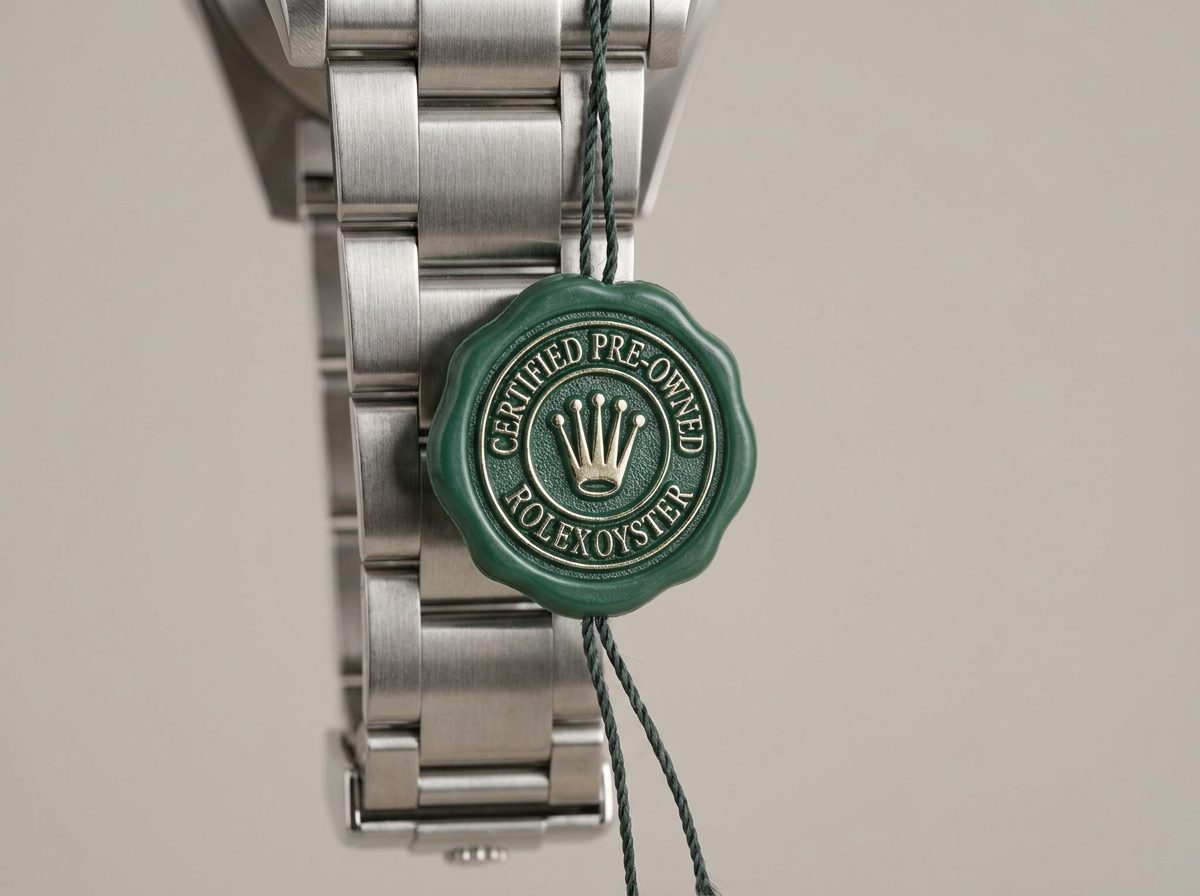
The primary structural mechanism of the CPO program is its strict three-year minimum age gate. Rolex explicitly mandates that a watch cannot enter the CPO certification pipeline unless it was purchased from an Authorized Dealer at least three years prior. This age restriction is a highly sophisticated instrument of market architecture designed to solve the brand’s existential threat: immediate secondary market flipping.
If brand-new, current-production steel sports references could be certified immediately upon leaving the boutique, speculators would systematically strip authorized dealers of retail allocations and funnel them directly into CPO channels to harvest the 30 percent to 131 percent grey-market premiums. This would immediately cannibalize Rolex’s primary retail network and expose the primary list pricing as an artificial ration rather than fair market value. By enforcing the three-year exclusion, Rolex artificially isolates current-production sports models from official manufacturer-backed secondary circulation, forcing flippers to assume a multi-year carrying-cost risk. The waitlist theater remains unviolated.
Mainstream Commodity Efficiency versus Specialist Variables
Ultimately, a rigid, bimodal ontology governs the secondary watch market. It strictly separates standard, mass-produced luxury references from unscalable, bespoke artisanship.
In the “Mainstream Commodity Tier,” modern references are physically produced in the hundreds of thousands. These models trade in deep, highly liquid secondary markets characterized by over 5,000 active global listings on digital exchanges. This massive listing thickness removes information asymmetry, creating near-perfect price discovery and highly compressed bid-ask spreads. Because the market for these modern “blue chips” is perfectly transparent and efficient, it behaves like a standard equity index. As Bolt puts it regarding mass-produced modern sports models: “You can’t make that market, right? In other words, that market is just what it is.”
In contrast, the “Specialist Alternative Tier” is defined by hand-crafted independent pieces (such as an F.P. Journe Chronomètre Bleu) that are strictly production-capped at fewer than 1,000 units globally per year. These references maintain extreme listing opacity, often with fewer than 5 active listings available globally at any given time. This thinness preserves severe information asymmetry. It is within this opaque, un-standardized realm that specialized horizontal knowledge and “cultural capital” act as the ultimate competitive advantage, allowing the collector to capture significant alpha.
4.4: Who's Buying and Why Now — The Demography of Desire
For decades, the high-end watch market resembled a private, localized salon. To the uninitiated, the secondary market was an opaque, fragmented trade where transactions occurred in the shadows of regional watch fairs and private dealer networks. Now in 2026, that closed salon has been completely dismantled. The global luxury watch pre-owned market has undergone a profound demographic and institutional re-rating, transforming into a multi-billion-dollar parallel currency market. This structural shift is underpinned by an unprecedented expansion of the global buyer base, a phenomenon that has shattered historical boundaries of age, gender, and geography. Reflecting on this explosive scaling of the trade, Bolt documents the sheer velocity of modern market entry: “The world and their mothers are dealing now, right?”
The 30-Year Wealth Window and the Youth Inversion
To understand the trajectory of modern horological demand, one must first discard the myth that mechanical watch collecting is the static domain of aging traditionalists. The empirical reality is inversion. According to data compiled in Boston Consulting Group’s (BCG) landmark March 2023 study, Luxury Preowned Watches, Your Time Has Come, the global pre-owned luxury watch market has climbed to a retail valuation of approximately USD 24 billion. This secondary engine now operates in direct dialogue with a primary, new-watch market valued at USD 54 billion, bringing the combined global horological matrix to a staggering USD 79 billion.
This multi-billion-dollar secondary pool is being aggressively filled by Gen Z and Millennial consumers. Deloitte’s Swiss Watch Industry Studies confirm that a remarkable 40 percent of Millennials and Gen Z consumers are likely to purchase a pre-owned luxury watch within a trailing twelve-month window—a forward-looking demand rate that is exactly double that of the Baby Boomer generation (20 percent) and significantly outpaces Generation X at 30 percent. In the macro global consumer landscape, nearly a third of all respondents (31 percent) declare an immediate intent to acquire pre-owned horology.
Younger buyers are structurally re-allocating capital toward timepieces based on a sophisticated mix of value-for-money (54 percent), aesthetic design (51 percent), and brand image (41 percent), balanced alongside an acute desire for immediate access to discontinued or highly allocated references (36 percent) that allows them to completely bypass primary boutique waitlists. The mathematical proof of this shift is absolute: Millennial and Gen Z buyers generated an astounding 61 percent of all pre-owned luxury watch requests on Chrono24.
The 30-Year Wealth Window: A demographic market driver where high-net-worth individuals reach peak capital capacity and systematically acquire the luxury objects they coveted but could not afford during their formative years (ages 18 to 25). In the horological market, this dictates the aggressive repricing of "neo-vintage" eras as successive generations (currently Millennials and Gen Z) rotate capital into their specific nostalgic targets.
A 2024 study by Jewelers of America reveals a 62 percent increase in jewelry penetration among younger men, with 73 percent of Millennial and Gen Z men now owning at least three pieces of jewelry, compared to just 45 percent at the turn of the decade. The wristwatch has become the apex expression of this masculine ledger.
Furthermore, this youth cohort has completely discarded the solitary collecting models of the past. Utilizing localized, highly interactive micro-communities like the RedBar Group—which has scaled to over 40 chapters and 3,000 active global members—younger collectors treat the mechanical watch as a highly social performance. They gather in major urban centers to compare bezel typography and case geometries, utilizing digital peer-to-peer price registries to bring near-instant transparency to the secondary market floor.
The Mechanical Correction of “Her-ology”
Simultaneously, the global demand engine is undergoing a structural gender correction, correcting a century-long failure of brand imagination. Historically, the Swiss watch luxury establishment treated the female consumer through the patronizing lens of pure, static ornament. The industry’s standard operating procedure was a cynical, reductive marketing strategy colloquially codified as “shrink and pink”: taking a historically significant men’s mechanical reference, downsizing the case diameter, inserting a cheap, mass-produced, battery-powered quartz movement, and encrusting the exterior with diamonds to mask the mechanical void within.
In the contemporary market, the sophisticated female collector has explicitly rejected this formula. The contemporary narrative has migrated away from the archaic, hyper-masculine myth of “conquering nature” and pivoted toward an intellectual appreciation for design architecture, geometric harmony, and unalienated human labor.
Deloitte’s market data reveals that female clients now command approximately 35 percent of total luxury watch sales in the United States—the single largest export destination for Swiss watchmaking, accounting for roughly 17 percent of total Swiss outbound volume. While Chrono24’s Her-ology report notes that women comprise 25 percent of active users on the primary pre-owned digital exchange, their specific transactional footprint is disproportionately high-yield.
Recognizing this immense, latent mechanical demand, former Audemars Piguet CEO François-Henry Bennahmias projected a permanent structural realignment of the sector, forecasting that women will represent a massive 45 percent share of total mechanical-watch buyers. By treating the watch as a piece of kinetic sculpture rather than a decorative trinket, the modern female collector deploys authentic cultural capital over superficial status markers, aggressively driving liquidity into mid-sized mechanical calibers.
Regulatory Arbitrage and Geographical Pivots
As demand broadens across age and gender, it is simultaneously executing dramatic shifts across geopolitical borders. The primary catalyst for this geographical reallocation is not aesthetic trend, but regulatory intervention and capital flight.
The global implementation of the Common Reporting Standard (CRS) effectively dismantled traditional offshore banking secrecy across jurisdictions. Faced with the total transparency of digital capital, the global ultra-wealthy systematically reallocated private assets into un-tracked, physical bearer instruments. The premium mechanical watch assumed the historical role of gold bullion, acting as an invisible store of absolute wealth that evades digital reporting thresholds.
This structural redirection of capital has been further supercharged by protectionist tariff shocks. The United States market design was radically altered when a sweeping 39 percent import tariff was slapped onto all Swiss-manufactured timepieces. Overnight, this regulatory barrier made brand-new watches in American authorized boutiques 30 percent to 40 percent more expensive than their global equivalents. This artificial price distortion on primary supply had an immediate, predictable economic consequence: it violently redirected domestic US demand into the pre-owned grey market, as buyers sought to bypass the tariff wall entirely, instantly accelerating the secondary market velocity of existing domestic stock.
Concurrently, the absolute center of gravity for horological acquisition has shifted toward the Asia-Pacific theater. Pre-owned appetite is now highly concentrated in hyper-affluent regional pockets, led by the United Arab Emirates, where 55 percent of consumers express an immediate likelihood to purchase pre-owned, followed closely by India at 54 percent and China at 52 percent.
In India, the market trajectory has entered an explosive, non-correlated breakout phase. According to official export tracking from the Federation of the Swiss Watch Industry (FH), Swiss watch exports to India surged by a remarkable 27.6 percent over the Jan–Nov window, finishing the year up an aggregate 25.2 percent to a record CHF 274 million. This dramatic expansion occurred during a period where global Swiss watch exports suffered a systemic contraction of 2.8 percent, proving India’s absolute insulation from broader luxury asset cooling cycles.
Deloitte’s India spotlight reveals a consumer profile defined by high intent and authentic utility: 54 percent of Indian consumers state they are likely to acquire a pre-owned timepiece in the coming year—the highest intent metric recorded anywhere on the planet—and 85 percent of those buyers acquire these pieces explicitly for their own physical use, anchoring the asset class in authentic lifestyle utility. This horological boom is sustained by a historic domestic wealth creation cycle, with India’s broader luxury market projected to scale from approximately USD 7 billion to USD 30 billion.
In China, the secondary landscape has achieved full institutional maturity. The Chinese pre-owned luxury watch market reached a valuation of USD 3,572.8 million, and is mathematically projected to double to USD 7,145.8 million, maintaining a compounding annual growth rate (CAGR) of 10.4 percent. The Hurun Chinese Luxury Consumer Survey confirms that luxury watch collecting has become the definitive status posture for the domestic elite, with 49 percent of Chinese High-Net-Worth Individuals actively collecting high-end horology—a staggering 23 percent year-on-year increase in collector density.
The Ultimate Verdict: “You Ain’t Seen Nothing Yet”
This global cross-pollination of new generations, genders, and geographies has permanently altered the terminal trajectory of the mechanical horological market. BCG projects that the secondary luxury watch market will reach an aggregate global valuation of USD 35 billion, while Deloitte’s long-term models forecast the pre-owned sector to settle at CHF 35 billion by the end of the decade—at which point the secondary market will officially comprise more than half of the entire primary industry’s value.
Faced with this massive, shifting float of physical wealth, primary manufacturers are no longer permitted to operate as simple factory assembly lines. To manage secondary market velocity (SMV) and protect their core brand equity from the structural threat of high-fidelity replicas, major houses are being forced to act as the central banks of their own inventory.
This structural transformation confirms that the valuation ceiling for top-tier horological trophies has vast room to expand. The globalized dealer network has converted what was once a tiny, subjective hobby into a continuous, liquid parallel currency.
4.5: The Honest Asterisk
Every great financial mania is eventually forced to reckon with the physics of gravity. In the breathless, speculatively driven environment of the early 2020s, a dangerous mythology took root: the assumption of universal, uninterrupted horological appreciation. Fueled by high macroeconomic liquidity, zero-interest-rate monetary policy, and the sudden wealth effect of cryptocurrency, the secondary luxury watch market briefly decoupled from reality. Steel sports watches were incorrectly perceived as highly liquid cash equivalents—a flawless, one-way bet.
But markets are ultimately driven by the ruthless mechanics of risk and reward. When global central banks tightened monetary policy in mid-2022 and crypto valuations collapsed, the resulting inventory-absorption choke exposed the volatile downside of alternative asset classes. The illusion of perpetual motion shattered, bringing an abrupt and punishing end to the pandemic-era bubble.
The Sizing of the Drawdown
During the “Great Correction,” independent market indices precisely documented the scale of the destruction. The Bloomberg Subdial Watch Index fell approximately 41 percent from its April 2022 peak, continuing its slide to post further losses of 6 percent across full-year 2024 to reach its lowest level since 2021. The WatchCharts Overall Market Index plunged approximately 32 percent from its March 2022 apex. By early 2026, despite a minor cyclical rebound of 4.9 percent in 2025, secondary watch prices sat 40 percent below their speculative highs, leaving peak buyers deeply underwater.
The primary symbol of this speculative financialization was the steel Patek Philippe Nautilus Reference 5711/1A (blue dial). During the post-discontinuation frenzy of late 2021 and early 2022, its secondary-market average surged to an irrational peak of $131,500 to over $152,000—against a last retail recommended price of approximately $34,890. As the market corrected, the 5711/1A experienced a severe contraction, falling back to the $80,000 to $110,000 range and settling at approximately $89,000 as of early 2026.
This correction violently exposed the “Liquidity Illusion.” In a bull market, buyers assume they can exit their positions instantly. But as speculators rushed to offload assets to cover losses, the available supply of the “hype trio” (the Rolex Daytona, Patek Nautilus, and AP Royal Oak) approximately tripled in a brief five-to-six-month window. Simultaneously, global auction sales contracted by 13 percent year-on-year. This supply-side glut completely paralyzed the market for mid-tier assets, proving that the true cost of cashing out fast is a severe capital haircut—typically 20 percent to 40 percent below the screen price just to incentivize a dealer bid.
For amateur flippers operating on margin, the consequences were devastating. Bolt exposes the sheer recklessness of this debt-fueled speculation: “there are people hurting. I know people that have borrowed money at 2 and a half and up to 4 percent a month to get into the whole Watch Games… and suddenly the stock they’re holding is worth half and they are in trouble…” As he notes regarding the symmetry of leverage: “The bigger the potential profit, the bigger the potential loss if you have to cash out of it.”
The 99% Fallacy and the K-Shaped Market
The Great Correction also laid bare the most pervasive fallacy in the industry: the idea that all luxury watches appreciate. They do not. Upon leaving a boutique, non-apex luxury watches immediately undergo car-like depreciation, reselling at a 30 percent to 50 percent discount relative to their Manufacturer’s Suggested Retail Price (MSRP). By mid-2025, Morgan Stanley’s aggregate data indicated that an astonishing 99 percent of luxury watch references across the broader industry traded at significant discounts on the secondary market. Attempting to extract financial alpha from the broad, mass-produced luxury middle market is an absolute mathematical impossibility.
Instead, the capital allocation architecture of the secondary watch market is defined by an extreme, asymmetrical K-shaped bifurcation. Financial growth and value retention are strictly concentrated in three privately held, sovereign giants: Rolex, Patek Philippe, and Audemars Piguet. According to 2025/2026 data, this trio controls more than 50 percent of the entire secondary market by value.
Out of 35 major Swiss brands tracked by Morgan Stanley, 28 brands recorded persistent price declines throughout the correction, with mid-tier names like Tudor, IWC, and Cartier trading at overall discounts exceeding -30 percent below retail. Even within the apex brands, value is ruthlessly polarized: while Patek’s steel sports lines like the Aquanaut (+80.3 percent) and Nautilus (+59.4 percent) carry massive premiums, their complications and Calatrava dress references fall into the same depreciative -30 percent discount bracket as the rest of the industry.
The Forensic Threat: Super Clones and Toxic Provenance
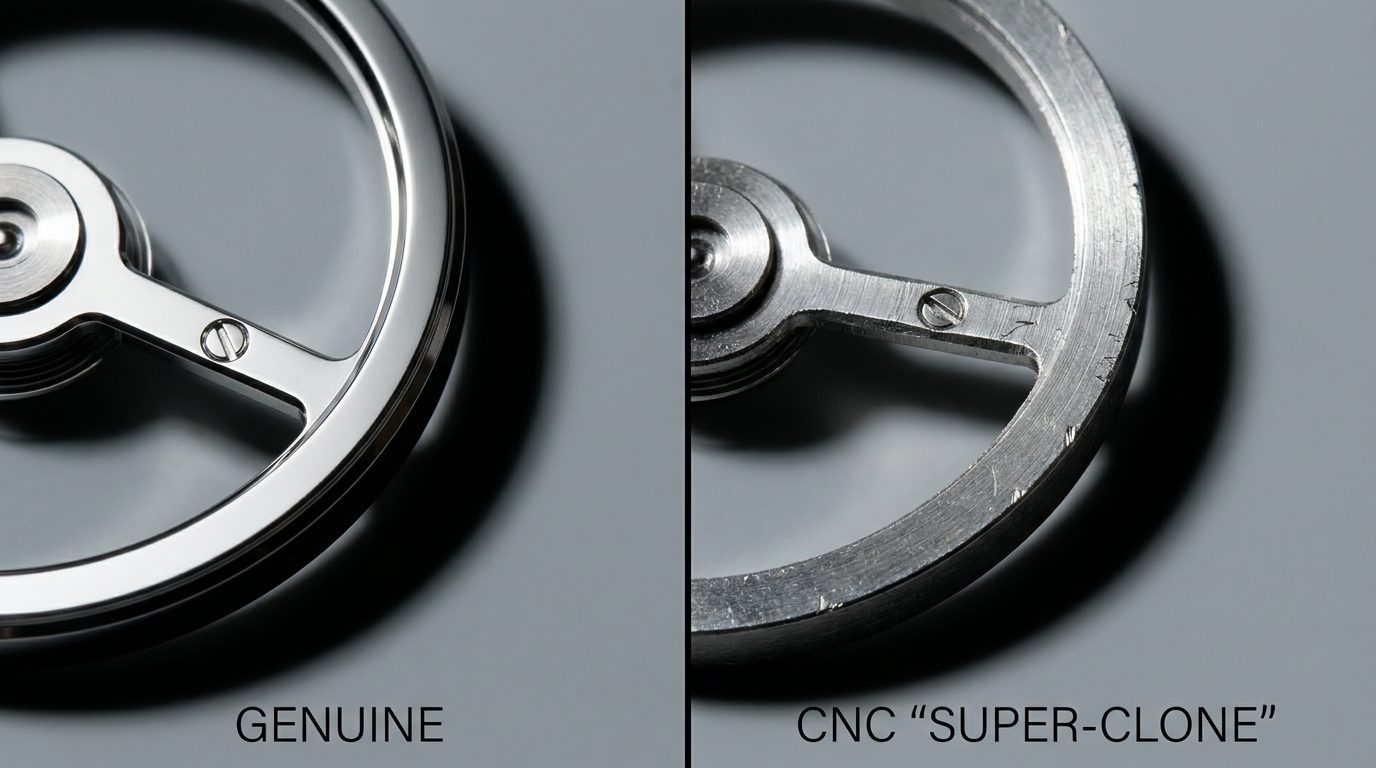
Beyond macroeconomic volatility, the modern collector faces a severe, physical balance-sheet risk: the industrialization of the counterfeit. “Super clones,” manufactured by illicit Chinese syndicates like Clean Factory and VS Factory, use 5-axis CNC machines and CAD files identical to those of the Swiss houses. With an estimated 30 to 40 million fake watches entering circulation annually—compared to Rolex S.A.’s genuine production of roughly 1.24 million pieces—the probability of encountering an un-authenticatable “bargain” is dangerously high.
“Frankenstein” configurations are designed to successfully pass visual intake at authorized service centers, receiving official brand service invoices. This effectively acts as horological money laundering, washing a counterfeit into legitimate pre-owned circulation via institutional paperwork. The scale of this contamination is vast; the independent secondary market trading platform Bezel reported rejecting a staggering 29 percent of all watches submitted for resale in 2024, a 6-point year-on-year increase highlighting the volume of modified or inauthentic watches clogging secondary transaction channels.
In the vintage sector, the forensic risk shifts to “toxic provenance.” Up to 90 percent of a vintage sports watch’s equity resides in the printed brass disc of its dial. Vintage modifications, such as “redials” (refinished or replaced service dials), result in a severe 50 percent to 75 percent valuation penalty. A non-original face strips the watch of the historical virginity and original patina that elite collectors demand, instantly destroying its viability as an investment-grade asset.
Blue Chips, High Beta, and the Equities Parallel
Ultimately, the secondary watch market strictly mirrors traditional financial equity structures regarding risk and yield. In the Modern “Blue-Chip” Commodity Tier, highly standardized, high-volume production references (like a modern stainless steel Rolex Submariner or GMT-Master II) behave like stable, large-cap equities. Because they trade in deep, highly liquid markets with over 5,000 active global listings, they possess near-perfect price discovery and narrow, compressed dealer margins of 3 percent to 8 percent. This uniformity guarantees liquidity but caps the potential for outsized, alpha-generating returns.
Conversely, the Vintage and Alternative Specialist Tier—hand-crafted, low-volume independent calibers or highly scarce vintage references—functions like venture capital or high-beta equities. They carry transaction risks due to the severe information asymmetries surrounding unpolished case geometry, original dial printing, and undisclosed laser welding. However, because the mass dealer market lacks the specialized forensic knowledge to manage these risks, expert allocators who “buy right” can capture wider wholesale-to-retail margins frequently exceeding 30 percent to 100 percent.
Bolt frames this dynamic, using a direct stock-market analogy to explain the inherent trade-offs between mainstream efficiency and specialized alpha:
“The world and their mothers are dealing now, right? The margins on modern watches are really quite minute, because so many more people are doing them and competing for them. Therefore, the margin is going to be so tiny. Like anything, it’s like stocks and shares. You want to go with blue chip, you’re going to get a smaller return. You want to go with something that could have bigger potential, there’s going to be slightly more risk. It’s exactly the same with wristwatches.”
The ultimate truth of horological investment is that the market is entirely unsentimental. It does not reward mere participation. As Bolt concludes: “Risk and reward, right? Like anything, it’s like stocks and shares.” To navigate the honest asterisk of this asset class, an investor must respect the gravity of the market, the ruthlessness of the K-shaped curve, and the uncompromising demand for forensic truth.